Road Trip Part 1: Northern France

When David's parents visited France a few years ago, they visited the Chateaux of the Loire Valley, and they wanted us to see it too. So, they "sponsored" us to head south in France as an engagement gift. The flood gates were open. There was more France we wanted to see than just the bus tours offered to the Loire, so, road trip!
We made a not-so-aggressive 3 week plan to visit the beaches of Normandy in the north, cut down to the center of the country for some Chateau hopping, do some wining and dining in the Dordogne, and then end south on the French Riviera with a beautiful coastal drive.
We're going to point out some of our standout highlights, while trying to avoid being painfully detailed and boring. Sadly, we don't have ANY photos from this trip, so again, we'll try to recreate the magic using photos from the internet. But, we've still got our memories, so here's the first part of our chemin trip.

We learned a few things right off the bat as we drove out of Paris. Toll roads are expensive, the French take the winter off, and they LOVE Adele. We quickly had to reroute our trip off highways and find some new radio stations. Soon we were experts at navigating roundabouts and deciphering French signage. After getting off course with our Google map a few days into the trip we stopped a bookstore to pick up a road atlas. Robin is a champion at navigating. We were on our way.
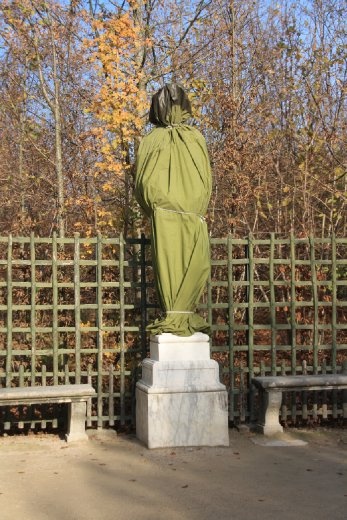
Our first stop was just outside Paris at Versailles to set the chateau bar. The palace interior is beautifully furnished with much of the original decor of Louis XIV, which was fun to see after seeing Mad King Ludwig's attempt at recreating Louis XIV's style (and insignia) at Linderhof in Germany. The hall of mirrors is one of the most impressive rooms, meant to look like an endless hall of chandeliers. Unfortunately, the palace grounds are much less impressive in the wintertime, with nothing in bloom, many of the flower beds dug up, and statues tarped over so that they resembled body bags more than bodies. We spent a couple hours exploring less than a quarter of the immense gardens. On one of the outer edges we found a peasant village Marie Antoinnette had constructed so she could visit and experience the peasant life style must be like. She even had her very own 2 story thatch hut constructed for authenticity. It was her escape from the palace without having to deal with things like actually being a peasant.
Best tip:
Book your visit to Versailles online ahead of time for about half the cost of buying it at the palace and you skip the ticket office's crazy line of confused tourists from around the world.

Honfleur
Our next stop was the old port town of Honfleur. The city dated back to the 15th century and managed to pack 600 plus years of charm into its small wooden harbor - the subject of many budding impressionists' painting studies. The town is known for seafood, and when we pulled after a a quick lap around the harbor we'd found a local mid-range seafood restaurant. David started his culinary tour of France, blindly ordering the seafood platter without knowing the translations for any of the foods. One particular item he didn't recognize, he pointed out to the waitress and she translated it for us as "welk." Which, when our appetizer arrived, we found out were sea snails. The special seafood platter included cold langoustines, sea snails, tiny gooey clams, a couple shrimp, and oysters served on a bed of black seaweed leaves. Robin opted for the mussels with a gorgonzola sauce served in a small black pot, traditional for the region. Robin tried to count how many mussels were in the pot, but got lost somewhere after 100. It was a challenge for both of us.
We stayed north, aiming for the shores of Normandy. We quickly became seasoned road warriors, sleeping at trucker hotels and eating at road side chain restaurants since dining out in France gets so pricey. A few of our chain culinary highlights include: La Tonnelle, meals starting at $15 including all you can eat French cheeses, desserts, appetizers AND an all-you-can-drink taps of beer, cider and wine. The French customers exercised their self-control better than us. Another restaurant was The Buffalo Grill which has a country home feel, including a "kitchen counter" where a lady grills everyone order over an open flame in the middle of the restaurant. All the meals come with beans and a salad, and to keep it authentically home style, the waiter comes around every time your plate starts looking empty and gives you more food. And lastly, Le Poivre Rouge (The Red Pepper), which is only really notable for their cute logo and their lack of red pepper.
D-Day Beaches

Our loop north brought us to the beaches of D-Day in Normandy. We scurried across the internet, downloading podcasts and articles trying to learn more about what we were seeing. We passed through empty beachtowns, full of would be tourist restaurants in the summertime. We were pretty accustomed to seeing beach cities, but it was weird because every beach city we passed through had some kind of memorial for WWII in it's center. Some cities had a tank, others had gun turrets lining the sidewalk. We stopped at Le Charleston, a faux American Diner with an ocean view overlooking the Nazi bunkers on the water while reading articles about the events of D-day. It was a very whacky and sobering experience over a lunch of pizza and beer. Our next stops were through the beaches where the D-day operation took place.

We hadn't realized that Canada had played a major role in the campaign on D-Day. We came across the Canadian memorial at Juno Beach first, since it's the furthest east, and were really taken by the gravity of being at the site.
As we continued along the coast, we tried to envision what the conditions must've been like during the war, imagining the sentiment in the occupied French towns along the coast, to the boats converging on the coast for the attack. All of it seemed awful.
Our guide to visiting the D-Day sites taught us a lot about D-day, including about the man-made harbor created by the British military after the beaches were captured by sinking giant pieces of cement roadway to create a breakwater to offload supplies. The sights were almost surreal, but looking out and seeing the harbor still intact made the war seem very present. The most striking were the cliffs of Pont du Hoc, our final destination for our D-Day tour.

Pont du Hoc was much farther than we expected and we had assumed we were lost several times before a re-assuring sign would pop-up telling us "Pointe du Hoc" was just down the road. Nothing our guidebooks told us prepared us for the craters that we saw. The cliffs were riddled with giant holes left from mortars that hit them, some a person's height deep. It leaves with a real sense of how horrifying the war must have been. This was also further reenforced when headed to Omaha beach and saw the American cemetery sprawling almost endlessly from the visitor's center. It was row upon row of white marble crosses, interspersed with stars of David representing Jewish soldiers.


The visitor's center itself is an incredible telling of D-Day, and is one of the only informational centers/museums that's free to enter. We arrived just before closing, and drove the half hour back the next morning to see the exhibit in its entirety.
When we'd decided to go to the beaches, it was more because we were in the area and felt it would be un-American not to, but we were surprised with how strongly we were affected by the sights.
When we'd decided to go to the beaches, it was more because we were in the area and felt it would be un-American not to, but we were surprised with how strongly we were affected by the sights.
 |
| Our delightful hotel |
Bayeux
After a sobering day of sightseeing, we pulled into this small town not knowing what to expect and ended up at delightful little hotel that was a converted 18th century mansion run by a bubbly old French woman. Describing things as delightful make us feel like we're getting either boring or old, but the place was downright delightful. As we did some research online that night, we found the town is known for its large church, which we looked at completely, and the Bayeux tapestry, a few hundred foot long carpet with a story of a battle during the Reformation in 1066. At $10 to look at it, and having a very detailed color brochure in hand, we decided to pass in favor of finishing up our D-Day drive.
Mont St. Michel:

We were searching for must see sights in Northern France and quickly fell in love with the postcard perfect photos of Mont St. Michel. It's a tidal island a kilometer off the coast in Normandy, capped with a Disneyesque monastery. The island has had a fortification role for centuries, and has housed a monastery since the 8th century - although it had a brief stint as a prison in the 1800s. We found a perfect place to stay - a small B&B with a view of the island right out the window. We originally wanted to walk across the mud flats to the island in low tide, but after reading of the dangers of the tide that comes in at 12mph (faster than we run) and the definite need for a guide to attempt the walk, we opted for the causeway. Apparently, though, the causeway has slowly disrupted the water and has stopped Mont St. Michel from being an island. A problem that they're planning to solve with a new bridge soon.
 The population of the island is a whopping 41, and even in this lowest of low seasons the population was probably squared with tourists. We wove our way through the contents of a Japanese tour bus to the top of the island and wandered the grounds of the famous monastery. We considered stopping by a restaurant for one of Normandy's famous omelettes, but with a price tag of 30eur per we thought we'd wait and make our own less-famous version for a 10th of the price.
 David's parents had visited the island a few years earlier and remembered another delicacy, pre-salted sheep. The sheep feast on the salty mud flats around the island, which apparently results in a more savory meat. However, in low season we were out of luck in finding it. We found one farmhouse/restaurant that cheerily announced that they did have it in stock, but that was followed by the announcement that they weren't open.
Instead, we opted for drinking in the local flavors with a stop to a calvados maker. Calvados is a very potent alcohol made from apples. David, our trusty driver, was feeling tipsy after a single sip, so we cut our degustacion a bit short and bought an innocent bottle of apple juice for the road instead.
St. Mâlo and Dinard

The towns of St. Malo and Dinard sit on the shore of a small bay. St. Malo is an old heavily fortified city that has become a tourist destination for centuries. Doing this road trip in January was definitively outside tourist season, so many of the charming smaller towns we'd pass through would be almost wholly deserted and all you could do is window shop without an option to buy. The city was amazingly well maintained and updated, so there were many old store fronts with modern art galleries and high end apparel inside. After a few laps around the city, the cold got to us and we exited through the giant doors to the city and drove across the harbor to Dinard. We booked an AirBNB that we hadn't heard back from and so we pulled into a McDonald's to try to reach them. We didn't realize the host was from America, no less California. We got very nervous and excited at the prospect of hanging out with Americans for the first time on our trip. When we found the place, 5-stories up a steep staircase, we packed our hiking day pack with a night's change of clothes and settled in.
Dinard was a quaint city, with a nice paved shoreline, a beachfront casino, and a handful of restaurants open for the off season. We chose a crêperie, a specialty of Brittany, to share a couple gallettes, a savory buckwheat version of a crêpe. David spotted an andouille sausage and egg gallette. As we've already seen on this road trip, David likes to try the menu items he doesn't know how to translate. When our dishes arrived, an unsavory scent arrived at the same time. Robin kept asking, "What is that smell?" When David offered her a taste of his gallette, she found out. The next day we told our American host about our gastro adventure and she told us that andouille sausage is just a pig intestine rolled up and sliced. Mmm, mmm.
After taking in the sights - and tastes - of the North, it was time to head South and into châteaux country! Read more in part 2.
Best Tips:
McDonalds is your friend. If you're traveling through Europe and need an internet connection or affordable cup of coffee, look no further than Le Mac Do. Plus, it offers a great insight into French high school culture.
F1 Hotels. We had been using booking.com to search for affordable lodging on our trip. But from our AirBNB host in Paris, we learned about F1 hotels, part of a hotel chain owned by the same people that bring you Hotel Sofitel and the Pullman hotels. These hotels at the bottom of their portfolio offer clean and well appointed rooms at CRAZY low prices. And semi truck parking, too, if you're interested. Every hotel has the same layout and we found ourselves moving from one hotel to the next, but feeling like we were in the same place.
Best Laughs:
Brittany is known for their Camembert. Here's the camembert section in a local grocery store.


No comments:
Post a Comment