 |
| Our only remaining Mannheim photo... David's Opa's house is by the tower in the background. |
David's grandmother, Oma, told him stories about how the family used to be wealthy, owning a large estate where famous musicians would come to visit. "And the Nazi's took everything," Oma would say.
This open-ended trip seemed like the perfect opportunity to visit Mannheim and uncover David's roots. When else would we have unlimited time to travel to the less touristed parts of Germany?
We'd looked online to try to find info and even checked the database of names at the Jewish Memorial in Berlin. Everything that came up was for a different family that just happened to share David's last name. As a last effort, we tried Yahoo Answers the night before we were to arrive in Mannheim, to see if anyone knew of any resources to check in person once we arrived. The meager response we got was all criticism at our haphazard, unplanned approach to a genealogy trip:

Spirits still high, we decided to just try our best in the two days we had in Mannheim. We arrived in the city with a photocopy of Opa's passport and a birth announcement from 1915 with their street address - a street that no longer exists in 2012. At best, we were hoping to find out the current name of the street and visit his old address.
 We got off the train after dark and saw that Mannheim was now a completely modern city in every direction we looked. It was hard to imagine David's grandfather walking these same streets, since the city looked like it was born in the 1950s with no intention of restoring the past after allied bombings. Even the hallmark narrow winding streets we'd grown accustomed to seeing in old European cities were nonexistent. The whole city was on a grid with blocks named by number and letter, and no street names. We immediately began to doubt that Opa's house would still be standing, or even if his street was still around under a new name.
We figured our best bet would be to try the library in the morning to dig up some pre-war maps of the city to see if we could find where the street used to be. Since we had no other ideas, we decided to check out the tourist office to get their advice on which library to go to. He told us about a different place, which he only knew the word of in German, where old books were housed. In Nuremberg, Josh had told us about how his German coworkers knew all kinds of specific words in German that we had no equivalent to in English, so we figured that this was one of those cases. We suggested "historic library" or "city records" and he refused both of those to be correct. Not until we got to the building he sent us to did we see the huge sign that read "ARCHIV". For some reason, the German pronunciation of "ar-sheev" was totally unfamiliar to us. We ended up paying him another visit to let him know that not only do we have a word for that in English, it's actually a cognate. Oops.
The Archiv was indeed the right place. The office was slow that week because of the holidays. So slow that over half the office was out on vacation and the few that stuck around were just hanging out. After testing multiple locked doors and bothering multiple sparse departments, we were escorted to a small office at the end of a long hall where we met Karen. Who apparently was just hang out waiting for someone like us. We told her about Opa and showed her what we had, and she hesitantly asked how long we were staying in Mannheim. We told her sadly, only until tomorrow, and she was relieved. "Come back at 4 and I'll have some things for you."

We were shocked to find that in the 3 hours we'd been away, Karen had come up with enough information to fill a presentation of as many hours. We found out the names and occupations of David's grandfather's parents and both sets of their parents. We saw a photo of Opa's sister, and photos of David's great great grandparents' gravestones, along with directions to find them in the Jewish cemetery. She also had written confirmation of the famous musicians that used to come visit their house.
On the subject of the house, she wheeled out a huge multi-page hand-drawn map of the city with each building color coded by percentage destroyed in the war (see photo on right). And it was sadly confirmed that all we would see of Opa's old house was what was built on top of the bomb-destroyed building. But she had photos of the street from the late 1800s, so it was easy to picture where he grew up.
Our trip was a success. We left with two large packets of print outs, a deck of Jewish life playing cards, and Mannheim postcard replicas from 1908. Normally the service for the research is $50, but it's free for Jewish descendants affected by the Nazi party.
 |
| The office building where the house stood. |
Although Opa's house was clearly nothing like what it had been, the view was still very much the same. We strolled around the park, Opa's old stomping grounds. In that same moment when it began to set in that David was walking in Opa's footsteps, a green parrot came flying by. Opa hated David's pet parrot. It must've been a sign.
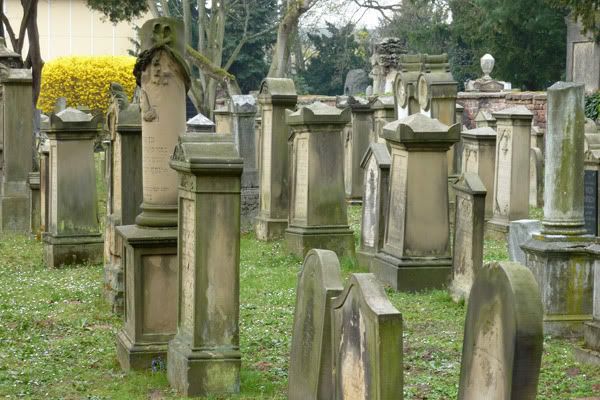
We crossed the river and made our way to the new Jewish cemetery to see where David's great grandparents were buried. We accidentally saw the next-door Christian graveyard first, with its manicured lawns and beautiful funeral arrangements, but caught a glimpse of the Jewish cemetery through an ivy covered fence. Here, all the graves were unattended and no headstones dated later than the 1940s. Some were falling over, and the trees had almost a fluorescent green moss on them. Somehow, David's great great grandparents' plots were almost next to each other, though they weren't to be connected for another generation. Imagine the photos we took!
Our mission was accomplished. We'd found all the connections we were searching for, and more. Our next obstacle to tackle was how to affordably make our escape to Paris, which proved more difficult than our entire genealogy search. Stay tuned!
Best Sights:
 |
| Pre-war city map |
 |
| Medieval city map |


The main square of Mannheim is an art nouveau masterpiece. The lamps and columns had faces on all of them. We got to see the last dregs of the Mannheim Christmas market there.

No comments:
Post a Comment