Friday, December 30, 2011

Disneyland Pour Us


Disneyland Paris, Paris, France
Sadly, we are left without any photos from our stop at le happiest place on Earth, so we're again using photos from the internet to make our point...and we do have one.


As Southern Californianers, we, like everyone else (right?), owned Disneyland Season passes the year before we left for Europe. Our favorite time of year to visit was at Christmas time, and we weren't about to let a trip to Europe stand in our way!

So with Germany, Austria, and Scandinavia under our belt, it was time to visit the capitol of Europe: Disneyland Paris. We were excited to see how the park would translate overseas to an audience that would likely be less enchanted by castles and un-familiar with "Main Street USA."

Dear friends and readers and internet searchers: This is a deviation from our usual type of posts, and it's more for the benefit of any people considering going to Disneyland Paris. So it might be overly detailed and "reviewy" (read: boring).

The park was easily accessed by train, which made it feel a little commonplace being just a stop on the Metro line instead of a "destination." After our change of itinerary in Strassburg, our visit to the park was en route to our next stop in Paris, which meant that we hit the park with all our (4!) bags with us. (BEST TIP: The park has a convenient luggage hold right by the entrance, and it's cheaper than the luggage lockers at the train station). Our first impression walking into the park was that it was like Anaheim's Disneyland placed on twice as much land. The park immediately feels bigger. Not necessarily better, just sprawling with more land than they were sure to do with.  It was kind of like walking through twilight zone Disneyland -- overall it looked the same but all the proportions were off and details were different.


Main St., USA is more of a Boulevard, seemingly wide enough to be a divided road, and lit with street lamps themed for each Disney princess.  There's less emphasis on Main St and more on USA: the all-American decorations are complete with giant drawings of Ellis Island and the beautiful Statue of Liberty (a gift from France to America, don't you forget it!). The street also had covered arcades on each side, accommodating the not so Californian weather. The parks seem to have been built by a French team whose task was to rebuild Disneyland in France based on photos and short park visits. Some things feel identical and some just feel like French interpretations of Americana, like Casey's Corner, a 20's baseball themed cafe with hot dogs, milkshakes, coffee and BEER! Also, the layout of the park is nearly identical to Anaheim's which made navigating very simple and made everything feel even more bizarro-Disney.

The centerpiece of the park, like in California, is Sleeping Beauty's castle. We'd read that they put a lot of work into making this castle more interactive and larger than the American version, maybe to keep the castle -overloaded French interested. It was one of our favorite parts of the park, with a second story and balconies, and a cave below with an animatronic sleeping dragon that moves just enough to keep the kids guessing. We actually visited the castle to escape a quick downpour, so imagine here some beautiful photos of the castle spotlit in the rain.

The other nice decor surprise in Adventureland. Since the park is newer, they were able to incorporate an Aladdin section of "town" into this area, and it has the prettiest architecture of both parks, in our opinion. But, the rest of Adventureland was pretty much the same feel as California's park.

Tomorrowland, called Discoveryland, was the least copycat area, with a very foreign feeling Jules Vern vision of the future with jagged looking neon/pastel/metallic windswept space rocks jutting out making for 
That's space mountain. Weird, right?
futuristically narrow walkways in places. Space Mountain: Mission 2, was also totally re-imagined and, we'd say, better than its California counterpart. The ride starts with the car sitting still almost vertically on a track, laying you on your back as you hear a countdown to launch which starts the ride off at full speed amongst a blur of lights. The ride is a full speed roller coaster in the dark with a proper loop de loop thrown in. 
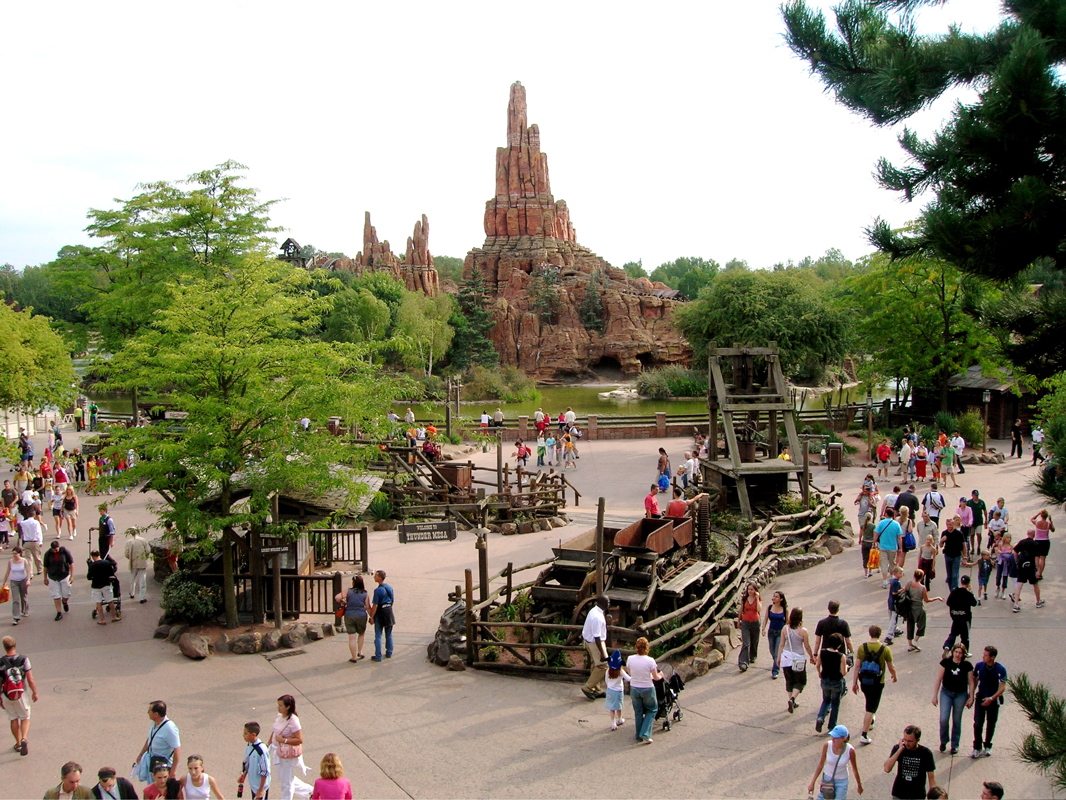


Frontierland was so sprawling, it actually felt like a frontier. It looked very similar to Anaheim, but with an extra mountain range and an easier to access island. Big Thunder mountain was our first ride of the day. For a ride built in the 80's they did an amazing job aging the decorations. We had plenty of time to admire the aged ironworks because the with the line management, one line cleared out, while ours stood still. We, like good Americans, scoffed that this would never happen in California. But the ride itself was also longer —and more thrilling— than the one at Disneyland.


All around, the roller coasters were better in Paris, and most of the non-roller coaster adventure rides had been transformed into roller coasters. The Indiana Jones ride was a full roller coaster using a mining cart theme from the movie. The ride is called Indiana Jones et le temple du Peril.  At the second park, called Walt Disney Studios, there's a ride designed by Aerosmith with a matching soundtrack called Rockin' Roller Coaster avec Aerosmith. The ride feels like space mountain, but with big hair and 80's appropriate colors. David got a big kick out of the staging area for the line because it looks like a no frills lobby for a record company, complete with bored interns paging people on the intercom.

One of our favorite pics
 that was lost.
Imagine this is David.


Eating in Disneyland Paris is a very expensive proposition, with a slice of pizza costing around $10. So we got creative and left the park to visit the adjacent metro station's French version of 7-11, Huit a Huit. We had a lot of equally cheap company shopping for lunch. Two sandwiches, a can of Pringles, and a bottle of wine later, we sat down to watch WD Studio's stunt car show Moteurs, conducted half in English, half in French. It was tres fun, but our favorite show was Cinémagique with Martin Short. No, not live. Probably the best thing that's unique to Disneyland Paris.

The park didn't disappoint in the Christmas spirit department, either. Mickey and the whole gang got together to speak some French and sing some Christmas carols. And to introduce us to....Duffy! Who is Duffy, you might ask? Apparently it's Mickey's teddy bear that he forgot to tell us about 'til this year. And it's available at the gift shop. Take that, Build-A-Bear! Duffy was all over the park, maybe making up for all that lost time.  Winnie the Pooh did not attend the Christmas parade, as he was off sulking that his 15 minutes of bear fame were up.

Best "Huh"s:
- Although the Haunted Mansion was almost identical to the California version, it ended with a random animatronic Wild West turn, with gun slinging cowboys.


Thursday, December 29, 2011

Stressburg


Straßburg/Strasbourg, France


Our time in Germany was quickly coming to an end and we had pre-booked an amazing Hotwire hotel deal at the Cheval Blanc in Paris for our next stop. Disneyland, Paris, but still. Now came the problem of getting there. Earlier online, we'd found overnight buses from Mannheim to Paris, and had been planning on that until we went to finalize our booking and found that those buses were completely sold out.  With our Disneyland tickets purchased and a hotel booked for the following night, we needed a plan B. Fast.

We looked into a train to Paris, and found that not only was it about 10 times more expensive than the bus, it was also a 200MPH train that shoots you in to the heart of (non-Disneyland) Paris in under 3 hours.  Which sure, sounds a heck of a lot more comfortable than an overnight bus ride, but for self-unemployed Yearopeans would mean paying for an extra night at a hotel in Paris and then navigating and paying to backtrack to Disneyland, which we weren't banking on.  So, on to Plan C.

Sadly, our sole surviving Strasbourg photo
We'd had a lot of luck in Austria and Germany with regional "partner tickets," good for unlimited travel for you, four friends and one dog within the region, as long as you stick to the slowest regional trains. We weren't social enough to take full advantage of the offer, but even for two people the tickets are a great deal.  So, we decided to grab a partner ticket for Germany, take it to the Franco-German border in Strassburg/Strasbourg (since it's a border town they get their city name in two languages!), and then transfer to what we hoped would be a similar option in France to slowly chug overnight to the happiest place on Earth in France.  There was no info about the French SNCF train system in Germany to confirm that this plan would work, but we were young and stupid (this was months ago, after all!) and decided to wing it. 

When we arrived in Strasbourg around 10pm, we were saddened to find we'd not only missed the last train out, but our visions of cheap regional transport weren't to be. So our first stop in France was to visit the ol' MacDo for some free late night internet research and a Chèvre McWrap.

That night, we slept in our most economy lodging yet, which felt more like a trampoline in a closet than a hotel room. By the time we'd sorted out our lodging, we had to revise our Disneyland plans. Since it was after 1am, we decided to scrap the idea of taking the first train to Chessy in the morning and spending all day at the park before our stay at the Cheval Blanc, and instead take a late afternoon train and go to Disneyland the day after, hopefully refreshed and well rested.  Plus, we'd talked to David's grandmother, Oma, that night, and when she heard we'd made it to France told us that we should try to see Strassburg if we had time, because that's where Opa used to work.  It seemed even when transit systems weren't on our side, Opa was. It seemed like a perfect way to end David's ancestry trip. And so began our most unexpected sightseeing stop: a half day in Strasbourg.
This charming city in the border region of Alsace Lorraine was a perfect transition into France. And it is also the self proclaimed "capitol of Christmas." Christmas markets were still going strong, and the town was bustling with tourists.  We spent the morning walking through plazas and crossing bridges with an audio guide we rented from the tourist office. 

The historic center is called the Grand Île, an island bordered by canals of the River Ill, with medieval half-timbered houses looking like they're about to tumble into the water. The higher stories of the houses are built out further than the main floor since real estate taxes were based only on the square footage of the ground floor. The prettiest half-timbered houses were in the Petite France neighborhood, which - though it sounds charming - got its name because of a hospital there that treated WWI soldiers with syphilis, known at the time as the French disease. There we learned that the dark color of the wood on the houses comes from a mix of animal blood and vinegar, and that the top stories were open balconies for drying hides.  It's definitely not livestock's favorite city, but the half-timbered houses were our favorites we'd seen the whole trip.

The city was so charming that we lost track of time, and had to run out of the cathedral to return the audio guide to make our train. Thanks to our impeccable time management skills and our failure to account for transit times (when teleporting becomes a reality, we'll be so on our game), it seems the majority of our exits are sweaty half-jogs to a transportation station. But this one was a full on sprint.  It was hard to navigate and keep pace, but somehow we managed to return the audio guide and collect David's ID, pick up our bags from our "hotel" and jump onto the train with about 30 seconds to spare. 


Best Sights:
River technology: Watching a tourist boat go through the locks on the river, and watching a swing bridge rotate, to let boats pass through.


Best eat and best laugh: We used our French for the first time on our trip at a locals' lunch spot to ask the guy at the counter if he parléed any English. The charming guy said he did - in perfectly unaccented American English. He gave us a rundown of the menu:  "So guys,you pick a burger and 3 toppings, including," he added with an exaggerated French accent and a smirk, "herbes de provence." We decided that the guy must be an American studying abroad.

"So, what'll it be?" he asked.

"We'll have, um, mushrooms…" (nod)

"corn," (nod)

"and chives." (He starts pointing at different bins of vegetables in confusion.)

We narrowed down exactly which bin held the chives while quickly revising our initial conclusion of him being an American, and asked him where he learned his English. He was a little embarrassed when he admitted his parents were both American although he was born in France.  We told him his English was great. He said, "thank you, and I learned a new word today — charves."

Tuesday, December 27, 2011

In Search of My Old Mannheim

Mannheim, Germany


Our only remaining Mannheim photo...
David's Opa's house is by the tower in the background.
Our final stop in Germany was one of two places we'd planned to see when we left for Europe. David's grandpa, Opa, grew up in Mannheim but fled to the US at 17 with his twin brother when the Nationalist Social Party came to power.

David's grandmother, Oma, told him stories about how the family used to be wealthy, owning a large estate where famous musicians would come to visit. "And the Nazi's took everything," Oma would say. 


This open-ended trip seemed like the perfect opportunity to visit Mannheim and uncover David's roots. When else would we have unlimited time to travel to the less touristed parts of Germany?

We'd looked online to try to find info and even checked the database of names at the Jewish Memorial in Berlin. Everything that came up was for a different family that just happened to share David's last name. As a last effort, we tried Yahoo Answers the night before we were to arrive in Mannheim, to see if anyone knew of any resources to check in person once we arrived. The meager response we got was all criticism at our haphazard, unplanned approach to a genealogy trip:

Spirits still high, we decided to just try our best in the two days we had in Mannheim. We arrived in the city with a photocopy of Opa's passport and a birth announcement from 1915 with their street address - a street that no longer exists in 2012. At best, we were hoping to find out the current name of the street and visit his old address.

We got off the train after dark and saw that Mannheim was now a completely modern city in every direction we looked. It was hard to imagine David's grandfather walking these same streets, since the city looked like it was born in the 1950s with no intention of restoring the past after allied bombings. Even the hallmark narrow winding streets we'd grown accustomed to seeing in old European cities were nonexistent. The whole city was on a grid with blocks named by number and letter, and no street names. We immediately began to doubt that Opa's house would still be standing, or even if his street was still around under a new name. 

We figured our best bet would be to try the library in the morning to dig up some pre-war maps of the city to see if we could find where the street used to be. Since we had no other ideas, we decided to check out the tourist office to get their advice on which library to go to. He told us about a different place, which he only knew the word of in German, where old books were housed. In Nuremberg, Josh had told us about how his German coworkers knew all kinds of specific words in German that we had no equivalent to in English, so we figured that this was one of those cases. We suggested "historic library" or "city records" and he refused both of those to be correct. Not until we got to the building he sent us to did we see the huge sign that read "ARCHIV". For some reason, the German pronunciation of "ar-sheev" was totally unfamiliar to us. We ended up paying him another visit to let him know that not only do we have a word for that in English, it's actually a cognate. Oops.

The Archiv was indeed the right place. The office was slow that week because of the holidays. So slow that over half the office was out on vacation and the few that stuck around were just hanging out. After testing multiple locked doors and bothering multiple sparse departments, we were escorted to a small office at the end of a long hall where we met Karen. Who apparently was just hang out waiting for someone like us. We told her about Opa and showed her what we had, and she hesitantly asked how long we were staying in Mannheim. We told her sadly, only until tomorrow, and she was relieved. "Come back at 4 and I'll have some things for you."
We were shocked to find that in the 3 hours we'd been away, Karen had come up with enough information to fill a presentation of as many hours. We found out the names and occupations of David's grandfather's parents and both sets of their parents. We saw a photo of Opa's sister, and photos of David's great great grandparents' gravestones, along with directions to find them in the Jewish cemetery. She also had written confirmation of the famous musicians that used to come visit their house. 

On the subject of the house, she wheeled out a huge multi-page hand-drawn map of the city with each building color coded by percentage destroyed in the war (see photo on right). And it was sadly confirmed that all we would see of Opa's old house was what was built on top of the bomb-destroyed building. But she had photos of the street from the late 1800s, so it was easy to picture where he grew up.

Our trip was a success. We left with two large packets of print outs, a deck of Jewish life playing cards, and Mannheim postcard replicas from 1908. Normally the service for the research is $50, but it's free for Jewish descendants affected by the Nazi party.

The office building where the house stood.
The next morning we found Opa's house, an office building across the street from the "Central Park" of Mannheim. We took a few "welcome home" shots of the outside of the cement 1980s building.  We had a photo of another house on the street in Karen's documents, and had taken a hilarious photo of David pointing at the photocopy and grinning at that same house behind him in the middle of the heavily trafficked street. The sapling in the photo was now a full grown tree. (However, please see "With France Like These, Who Needs Enemies" on why we don't have this photo). 

Although Opa's house was clearly nothing like what it had been, the view was still very much the same. We strolled around the park, Opa's old stomping grounds. In that same moment when it began to set in that David was walking in Opa's footsteps, a green parrot came flying by. Opa hated David's pet parrot. It must've been a sign.


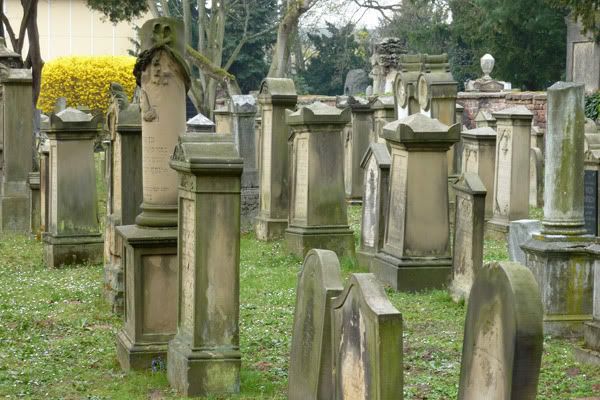
We crossed the river and made our way to the new Jewish cemetery to see where David's great grandparents were buried. We accidentally saw the next-door Christian graveyard first, with its manicured lawns and beautiful funeral arrangements, but caught a glimpse of the Jewish cemetery through an ivy covered fence.  Here, all the graves were unattended and no headstones dated later than the 1940s. Some were falling over, and the trees had almost a fluorescent green moss on them. Somehow, David's great great grandparents' plots were almost next to each other, though they weren't to be connected for another generation. Imagine the photos we took!

Our mission was accomplished. We'd found all the connections we were searching for, and more. Our next obstacle to tackle was how to affordably make our escape to Paris, which proved more difficult than our entire genealogy search.  Stay tuned!


Best Sights:
Pre-war city map
Medieval city map

The city archives had maps dating back to the 1600s. What we had thought was a modern grid plan was actually the original layout, which had been destroyed and rebuilt three times. 


The main square of Mannheim is an art nouveau masterpiece. The lamps and columns had faces on all of them. We got to see the last dregs of the Mannheim Christmas market there.


Sunday, December 25, 2011

Xmas Markt the Spot

Christmas in Wien & Nürnburg 

The holidays were upon us! Which meant homesickness, international traditions, and Christmas markets. 
Luckily we have some friends in Europe to stave off our homesickness, and they happen to live in some of the greatest Christmas market cities in the world.  So we decided to have an alliterative advent with Edgar and Eva then Josh and Julia for Frohe Fest. 

When we visited Edgar and Eva in October, they'd suggested we come back in December to experience their Christmas in Vienna. Christmas markets were a completely foreign concept to us before our trip to Europe. It's a staple tradition in all the Western European countries - a tradition that draws tourists from around the world.

Every country has markets transforming town square into rows of vendors selling ornaments, gifts and traditional holiday candies, cakes and alcoholic drinks. Hot Wine was present in every market we saw, called Vin Chaud (literally hot wine) in France, Vin Brûlée (for some reason) in Italy, and Glühwein in Germany and Austria. Edgar treated us by making his own homemade version for us without alcohol for the mother to be. Of course, David demanded liquor be added to his portion.

Vienna had several different Christmas markets throughout the city, but our first stop was the largest one at city hall. The plaza, which had housed a traveling circus on our first visit, was now packed with literally hundreds of stalls selling wooden and glass ornaments and toys, wool socks, and glühwein and punch, with an entrance marked by a glowing Wiener Christkindlmarkt sign. Each tree surrounding the the square had different shaped christmas lights. Some were just red balls, others had snow men, hot air balloons, and santa clauses. Eva told us they've been lighting the trees with different shaped lights since she was a child. The rest of the streets in the historic center were strung with lights, each street with a different motif. The whole city twinkled with the Weihnachten spirit. 

We learned a lot about Austrian Christmas traditions from E&E. In Austria, it isn't Santa Claus that brings the gifts, but a Christ child angel. This angel brings the gifts unwrapped and ready to play with on what we celebrate as Christmas Eve. Parents have the task of assembling all the gifts ahead of time so they're ready to go, and Eva told us about her parents staying up late at night assembling Legos. Also, along with the gifts, the Jesus Christ angel brings the tree, fully decorated, on Christmas Eve afternoon. Usually, the kids are whisked away for some all day activity so the parents can bring in the tree that's been hiding out on the balcony or at a relatives house and decorate it. (As a result, movie theaters are extremely busy on Christmas Eve day). 

We left Edgar and Eva to spend their Christmas day with their families, and we set off to Nüremburg to spend the holiday with our American friends Josh and Julia. David and Julia met in college, and hadn't seen each other since. We thought it might be weird, but it was a Christmas Miracle; we all had a great time. (Josh and Julia, if you disagree, please send us a private message instead of a scathing comment so you don't ruin the blog for our reader(s).) They have an amazing apartment in Nüremburg where they both work for Adidas World headquarters. After learning so much about European Christmases, we were greeted at Josh & Julia's by an American style tree (already up!), an American flag hanging on the wall, and a stuffed and mounted eagle to round it out. While Nüremburg was full of American tourists searching for the authentic German Christmas, we had found our slice of home away from home. 

We celebrated Christmas Eve with delicious home cooked Korean ribs and Irish Whiskey. With the Js, we all felt the need to watch a traditional Christmas movie: National Lampoon's Christmas Vacation. We huddled around the TV with a box of Trader Joes cookies and watched a more stereotypical, over-the-top American Christmas story than we'd remembered, [spoiler alert] which ends with the Star Bangled Banner. We were Americaning in style.

Best times: 
Rock climbing with Edgar in a converted 
17th century building, rekindling the memories 
of how they met almost a decade ago in San Jose.
Playing a Spaß (fun) game of Settlers of Catan.
Hopefully a new Weinachten tradition.


Touring the Adidas Factory with J&J, attempting to hide David's offending Pumas. And finally ending David's winter boot search at Rockport, now owned by Adidas. Das boot!


Wednesday, December 14, 2011

Here Today, Gondola Tomorrow


Venice, Italy


David's photo was probably even better
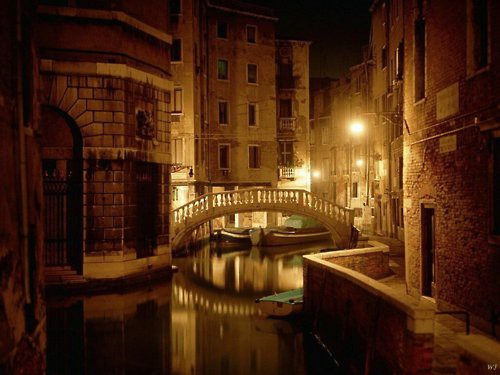
Had we been keeping track, we would have celebrated our 100th day of European adventure in Venice. As it was, we just celebrated the lack of tourists. We arrived in the evening, and were enchanted by glimmering Venetian gothic façades. Our hotel was nestled in a small piazza off St. Mark's square, and we were romanced by the idea of walking there from the train station, through the narrow winding streets over sparkling lamplit canals. But, 45 minutes into our hike and a dozen staircase bridges later, we were wishing we'd opted for a romantic public water bus instead.


We only had a few days in Venice and would have loved to spend more. Still, we had a great time walking the historic areas, armed with our pal Rick Steves, playing an audio tour in unison on our iPods, chuckling as we walked in the rain through a nearly abandoned St. Mark's square while Rick told us to elbow our way through the crowds.  He mentioned that in the rainy season, they sometimes have to assemble elevated sidewalks in the square due to flooding (which they call "alta acqua"). Sure enough, people were laying them out as we walked, drenched and crowd-fee.

It seemed like a mandatory to take a gondola ride in Venice, but we stayed budget minded and opted for a vaporetto water bus instead.  It's basically the same thing, but instead of the sounds of a gondolier singing, there's a noisy engine and loud thuds as the water bus docks at each stop, and instead of cuddling with your significant other you're bumping elbows with commuters. But it still let us see a side of Venice you literally can't see on foot (there are no sidewalks for a large part of the grand canal) and good ol' Rick helped out again with an audio tour of the sights, timed perfectly with the water bus schedule. Two thumbs up, Rick.

And we hit the water again with a trip to Murano to get a free tour and guilt trip of a glass blowing factory. We lucked into watching glass blowers work on a pineapple for the first time, experimenting with colors by dipping the hot glass into different minerals with different shades of green. They took their work seriously, and were armed with a drawing of a pineapple and a real model! Our guide told us that their hands are like catcher's mitts….they hold the metal stick straight out of the fire with no hand protection at all. We walked out resisting the temptation to buy ourselves any glass fruit. 

After a few quick days of sight seeing, we were itching to board another overnight train. And to complete our V trifecta with a return to Vienna.

Best Sights:
The floor of St. Mark's church, which looks wavy because of the marshy ground it was built on.

Best Eats: 
Le Bistrot Venice, where the waiter spoke 6 languages (cockily). Our lunch special had the most impressive plating we'd ever seen and our dessert came with sugar encrusted rose petals. And powdered gold. One of our more delicious/unnecessary meals.

Osteria on Murano Island. After the glass factory, we got a recommendation from a glass store owner for a restaurant down a narrow alley where he said he ate lunch every day. The restaurant is very simple and was full of glass and construction workers. For 6 euros, you get a plate of fresh fish, battered and fried and for 2 euros more, a pitcher of wine. It was one of our most affordable and delicious meals so far. Two thumbs up, glass store owner. 

Best Brags: 
After our lunch, the restaurant spit us out on the locals side of the island. David had snapped our wine bottle opener in half the night before so we found a small kitchen supplies store. We chatted up the shop owner about bottle openers. She asked if we lived in Italy because our Italian was so damn passable. Two thumbs up, us.

*We're still working our way through our "dark period," so these photos are randoms from online. We're not claiming any ownership of these photos.

Tuesday, December 13, 2011

Ma Ma Ma My Verona


Verona
Or, the 1st of 3 Vs

We chanced upon Verona as a money saving 24-hour stop from Bologna to Venice and were glad did. En route, we were surprised to find 2 whole pages in our guidebook devoted to the city we didn't intend to visit. Our "hotel" was a 45 minute walk to the train station in pouring rain. (Or a dry 2 euro bus ride, but that's not how we roll.) This gave us our first opportunity to put our rain gear to use and look like total dorks as we walked down charming pedestrian shopping streets and through beautifully lit Christmas piazzas.  Almost all the old buildings in Verona had a distinctive candy cane motif that gave you the sense that city was meant for Christmas markets.

For December, every city square had a Christmas market, and there were dozens of them, each with their own nativity and theme. One of them was German themed, selling sausages and sauerkraut.  

But the most stunning and fun square was Piazza Bra, bookended on one end by an arch with a gorgeous clock, and on the other by the ancient Roman Arena.  For the holidays, they install a giant white metal star of Bethlehem shooting out of the top of the arena and landing in the square. They apparently do this every year, and we were stumped as to how they assemble and disassemble it, and where they could possibly store it between seasons.

We happened to arrive during the two day festival of Santa Lucia, for which Piazza Bra had a huge market with a Target-like selection of gifts from wool socks to miracle mops and space saving hangers we were 25 euros away from buying.  We spent both our evenings window shopping the stalls.


Just like in Prague, Verona had a tourist card with a checklist of sights, few worth seeing.  But with our huge bus savings from the night before, we opted to go for it and see almost all 15 listed sights. We hit the arena first, but our visit did nothing to solve the mystery of the workings of the star. But it was almost as colossal as the Coliseum, so we were pleased.

Then, we church-hopped around to the city's most famous churches, walking in skeptics and walking out believers in our museum pass. San Zeno was built so that the ceiling resembled the bottom of a wooden boat, with 1,000 sculptures. Even though much of it was destroyed during the war, it was a sight to see.  But St. Anastasia (left) rivaled it for best Veronese church ceiling, with completely painted domes and more of our favorite red and white stripes.


And this is David
Imagine this is Robin
Our tourist card also took us up to Juliet's "house." The highlights are actually in the courtyard outside the house, with a statue for good luck boob rubbing, a gate filled with lovers' locks (either a new phenomenon or they get clipped off annually), and a wall covered in love notes stuck on with gum. But, determined to get our money's worth, we pushed on to the museum inside the house, and were rewarded with a questionable Juliet's balcony, clothes from Romeo and Juliet movies, and our favorite: a room where you can go 21st century and write an email to Juliet instead of all that archaic note writing going on in the courtyard. We're still awaiting reply.

Dear readers, you'll also be pleased to hear that this pass covered bus travel, so we rode in style back to the train station to continue our V trilogy. Next stop: Venice.


Saturday, December 10, 2011

Our next post has a name, it's B-O-L-O-G-N-A


Assuming we have any devoted readers, we apologize for our painfully long hiatus. We hope to get back on track and somehow caught up. For now, enjoy our upcoming posts describing the holidays in Europe

Bologna

Our sole surviving photo from Bologna from our stolen camera. Robin on the world's longest arcade.
After a month of being settled in Altamura, it was time to get back on the move. We were offered a ride by our new Italian compadre Lorenzo out of town, but after waiting to hear back from him, it turned out not only could he not give us a ride, but he didn't actually have a car. We priced out an escape plan to return to revisit Edgar and Eva via Bologna, Verona and Venice. 

We took our first overnight train of the trip, but were well prepared and got a decent night's sleep. Then we had a predawn stroll through Bologna's entire old town to get to our hotel, getting to see a side of the city that few tourists - and apparently hardly any locals - see. We paraded down countless arcades past boarded-up Christmas markets, a sleeping ice rink, and Bologna's Two Towers lit up with Christmas lights. Then we reached the main squares, Piazza del Nuttuno and Piazza Maggiore, where we were greeted by our very first European Christmas tree...and a giant Neptune statue for good measure.

Later that morning, we got to see the city in daylight. And it quickly became one of our favorite stops of the trip. After the whitewashed limestone city of Altamura, Bologna was a feast for the eyes in reds, oranges, and yellows. Brick buildings and colorfully painted arcades line every street. Although the city did have its share of true "sights," what we loved most was just soaking in the city itself, Western Europe's oldest "university town."

Being a college town, Bologna also boasts Italy's only Apple store, so we gladly extended our stay to get David's Macbook fixed. Moot point now, sure, but at the time it was a delight.

Best Sights:
Archiginnasio: The first building of Bologna's university (1563), the oldest in Western Europe. Coats of arms of students and professors are grafitti'ed (in the original sense of the word) on the walls. And the anatomical lecture hall was complete with stadium seating, skinless wooden statues, a dissection slab, and an ornate carved wooden ceiling.


Best Times: 
Our first urban hike up to the Basilica Madonna di San Lucia, via the longest arcade in the world. After a 40 minute climb, David turned the corner into the church's courtyard, spotted a fountain, and said the words that now live on in infamy because of his mean and mocking travel partner: "Oh, cool. Water." New catchphrase: check.

David's palace haircut: the Palazzo Benzy was having a Christmas market, with a hairdressing fundraiser in one of the rooms. For 10 euros, David got the royal treatment.

Best Laughs:
We read about a free Christmas concert just down the street from our hotel, and spent a half hour looking for it before we realized we had the right street address, just the wrong city. It was a few towns away from Bologna. Bah humbug.

Best Eats:
For the city that invented tortellini, lasagna and bolognese sauce, Bologna's top rated budget restaurants seemed to fall a little flat. Perhaps we'd built up our expectations a bit too much, or had grown too accustomed to home cooked Pugliese cuisine (and pricing). But we ended up enjoying the ambience almost more than the food at the places we stopped