Or
Cairo-lling with the Punches
Or
What a Trainwreck (too soon)
Or
An Outrageously Long Blog Post
Cairo & Giza
 After our halfway thought-out decision to
book a cruise, we investigated our internet options onboard. Since the cruise was booked ostensibly as a
cost saving maneuver, we were resolute not to pay for Princess’s $0.75/minute
internet, knowing how easily that would add up.
Instead, we stayed up until 3am on our last night in Rome, hurriedly and
haphazardly saving websites and reviews about each destination as offline htmls
to read later as those destinations approached on the itinerary.
After our halfway thought-out decision to
book a cruise, we investigated our internet options onboard. Since the cruise was booked ostensibly as a
cost saving maneuver, we were resolute not to pay for Princess’s $0.75/minute
internet, knowing how easily that would add up.
Instead, we stayed up until 3am on our last night in Rome, hurriedly and
haphazardly saving websites and reviews about each destination as offline htmls
to read later as those destinations approached on the itinerary.
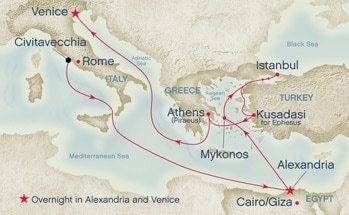
After two full days at sea, our first port
of call was Alexandria, Egypt, listed as “for Cairo,” or more appropriately,
for Cairo as a means to get to Giza to see the pyramids. The stop was overnight, arriving in
Alexandria early Monday morning, and leaving Tuesday evening. We had looked
over the cruise-provided “excursions,” with price tags of $4-600 per person to
get out to the pyramids, and thought, “we can do this on our own.” However, semi-successfully maneuvering
through and between major Western and Central European capitals does not prove
to be effective training for navigating the sensory overload that is Egypt. We had fortunately downloaded a lot of information
on getting to Giza from the port, and read and reread the info as we prepared
our first day’s itinerary. We planned to
tackle Giza on Day 1, since we would have until midnight to make the round trip
(2.5 hours each way) and see the sights.
The night before we arrived in Alexandria,
we had dinner with an interesting mix of people – 3 middle-aged women from
Nashville whom we couldn’t stand but had a trainwreck-like interest in, and a
couple from Manchester whom we were delighted with but couldn’t talk to because
of the Nashville Three commandeering the conversation. They asked which excursion we were planning
on doing – mostly as a thinly veiled segue to their plans – and on hearing we
were going it alone, started piling on the advice in redundant chorus. They reminded us of Pixar characters of Southern
hens, clucking to each other and stepping over each other to emphasize the
other’s points.
“Now,
no matter what, only drink bottled water.
And not just any bottled water….we heard a story from our travel agent –
“
“Yes, our travel agent’s husband drank the
Egyptian bottled water,”
“Yes, the Egyptian bottled water, and was sick for 6 weeks.”
“6 weeks.”
“Only drink American bottled water, and NO
fruit.”
“Yes, no fruit. Except for bananas.”
(Said together with gestures) “Because you
can peel them.”
“American bottled water, and no fruit.
Except for bananas, because you can peel them.”
The last sentence was almost like a refrain from the painful last ten
minutes, again repeated in a strange almost-unison.
The British couple revealed that they, too,
would be skipping a cruise-booked excursion, and one of the women again
cautioned, “only drink American water.” A funny warning to make to a Brit, sitting on
a ship drinking filtered seawater.
Day
1
More determined after the dinner’s
challenge, as we interpreted it, we woke up the next morning at an impressive
(for us) 7am, had a quick breakfast, and stepped out into the Port of
Alexandria. Our plan was to take a cab
to the SuperJet station (the Egyptian equivalent to Greyhound) and take the bus
straight to the Giza pyramids, then head to Cairo for the National Museum and
famous bazaar, and finally take a train from Cairo’s main train station back to
Alexandria, and a cab back to the port.
We had saved a few key pieces of practical and sightseeing info onto the
iPod, and taken a lot of mental notes on bargaining and prices to expect.
Immediately, Egyptian people appeared out
of nowhere, hawking postcards, small resin replicas of ancient statues, and of
course, cab rides. Despite reading
repeated descriptions of what to expect in our ‘research,’ it was WAY more than
we had expected. Although Step 1 of
Operation Giza was to take a cab, the constant harassing scared us and we just
kept walking, saying our newly learned “La Shukran” to everyone and pushing
into Alexandria slowly on foot. After
walking about 10 minutes from the port, the aggressive hassling gave way to a
friendlier calling out of cab offers, and after some hesitant eye contact
between us, we somehow determined we were both okay with this one driver. David haggled down the price from 30 Egyptian
pounds (5 dollars) to 20, and we set off for the Superjet station.
The cab driver was super enthusiastic –
about Alexandria, Cairo, Americans, his studies, and the potential that we
might use him again the next day. He rattled off the list of Alexandria’s
sights with excitement, and we started to worry (because we had read about it)
that he was going to take us on an all-day tour of the city instead of our
intended destination, but it turned out Superjet was just farther away than we
had thought. In spite of all the unease
of negotiating with these non-metered and unregulated cabs, the one plus is
that no matter how long it takes to get there, you’re paying by the destination
and not the minutes or miles.
The bus station was something. More accurately, it was not like a bus
station at all, but more as though street vendors had descended on a dusty
abandoned lot, set up shop, and invited retired charter busses and minivans to
the party. Everything was so dilapidated
it seemed surreal. And for us, the only
Westerners in sight, a little scary. The
conspicuous absence of harassing vendors meant that we were far away from the
tourist’s Alexandria, as well as from anyone who spoke English. We found a dusty old bus toward the back of
the lot that said “Superjet” in small gold letters as an afterthought to much
larger Arabic text. David poked his head
in the door and said, “Giza?” Two men
responded with a detailed answer of how to get to Giza, which was unfortunately
completely in Arabic, but it did involve pointing to a small shack a few yards
away, so we “Shukran”ed and nodded, heading over there. We repeated our lengthy “Giza” question, and
this time got tickets in response. We
had to wait a half hour for the bus, which put a minor dent in our streamlined
itinerary, but we were still excited that we had gotten this far on our own by
9:30am. Our $6 bus turned out to be
somewhat of a luxury for Egyptians, and we were surrounded by businessmen on
laptops and cellphones.
 When we started approaching the city
center, we saw a sea of unfinished buildings, with rebar jutting out of open
top floor columns. But these non-roofs
also had satellite dishes, and looking down to the lower floors, we saw people
were living in almost all of them, even in the ones without windows installed. We learned later ($400 information from a
couple who had been on the excursion) that you don’t have to pay taxes on
incomplete buildings, so everyone purposefully leaves their homes unfinished,
and builds on additional levels as their family grows, still never completing
the roof. As we got closer into Giza, we
started worrying that there were multiple stops and we didn’t know which to
exit at, so we took the advice of another passenger and got off at Giza
Square. A mistake (the bus apparently
goes right by the pyramids), but it made for an adventure. We stopped a group of teenagers to ask
directions, and one said a sagely “follow” and walked boldly into the
street. We stood amid dozens of mini
busses swirling around the intersection, with a man hanging out the door of
each, shouting the destination of the bus.
The boy called out to one of these ‘announcers,’ nodded, and gestured
for us to get on. We quickly and
awkwardly boarded, the panic of where to disembark again setting in. Thankfully, there was a group of university
students in front of us, one of whom spoke very good English. David said “pyramids” (which also luckily is
a very simple and illustrative hand signal) and she told us she would let us
know when to get off. The half hour bus
ride cost us 1.50 Egyptian pounds, which is less than a quarter for the two of
us. We spent the whole time staring out
the window in awe of near-collisions, listening to the lively mix of honks,
brakes, and shouting. Then a near
collision turned into an actual collision as our bus sideswiped a car. Both drivers got out to shout at each other,
and a growing crowd appeared, including a lot of our passengers. Finally, the man next to us looked at his
watch, got off the bus, and literally pushed our driver back in like the friend
of a drunk guy trying to get in a pointless fight at a bar.
When we started approaching the city
center, we saw a sea of unfinished buildings, with rebar jutting out of open
top floor columns. But these non-roofs
also had satellite dishes, and looking down to the lower floors, we saw people
were living in almost all of them, even in the ones without windows installed. We learned later ($400 information from a
couple who had been on the excursion) that you don’t have to pay taxes on
incomplete buildings, so everyone purposefully leaves their homes unfinished,
and builds on additional levels as their family grows, still never completing
the roof. As we got closer into Giza, we
started worrying that there were multiple stops and we didn’t know which to
exit at, so we took the advice of another passenger and got off at Giza
Square. A mistake (the bus apparently
goes right by the pyramids), but it made for an adventure. We stopped a group of teenagers to ask
directions, and one said a sagely “follow” and walked boldly into the
street. We stood amid dozens of mini
busses swirling around the intersection, with a man hanging out the door of
each, shouting the destination of the bus.
The boy called out to one of these ‘announcers,’ nodded, and gestured
for us to get on. We quickly and
awkwardly boarded, the panic of where to disembark again setting in. Thankfully, there was a group of university
students in front of us, one of whom spoke very good English. David said “pyramids” (which also luckily is
a very simple and illustrative hand signal) and she told us she would let us
know when to get off. The half hour bus
ride cost us 1.50 Egyptian pounds, which is less than a quarter for the two of
us. We spent the whole time staring out
the window in awe of near-collisions, listening to the lively mix of honks,
brakes, and shouting. Then a near
collision turned into an actual collision as our bus sideswiped a car. Both drivers got out to shout at each other,
and a growing crowd appeared, including a lot of our passengers. Finally, the man next to us looked at his
watch, got off the bus, and literally pushed our driver back in like the friend
of a drunk guy trying to get in a pointless fight at a bar.
A few minutes later, the pyramids came into
view as we rounded a corner, and the students confirmed (as we suspected) it
was time to get off. The hasslers, called touts, quickly found us again, which
on the one hand meant, yay, we were close to the pyramids, and on the other,
was the last straw on a very intense morning.
We spotted the hotel by the entrance that had been well-reviewed for a
great meal with pyramid views, so we hurried in, as much to escape the touts as
to get a bite to eat. We left the
restaurant at 2:30pm, shocked at how long this whole “doing it on our own”
thing was taking.
As we left the hotel, the a doorman donning
a fez asked us if we needed help. We
told him we were just headed across the street to the pyramids, and he said,
“on foot?! It’s 8 or 9 kilometres to
walk around inside. I can get you a 2
hour tour by a driver in a private car for 125LE.” We said no and walked away, but then he said
120, and we thought that 20 USD was a good deal for a 2 hour tour and this
well-reviewed hotel must be must be trustworthy. Another mistake, as we had forgotten one of
our websites had said “people will insist you can’t walk the grounds. You can.”
This entered us into the most upsetting
part of our day, as our friendly driver turned out to be a total scammer. Our “2 hour tour” turned into him dropping us
off at his friend’s camel stable to pay another 125LE to ride camels into the
site, as the driver warned, “It’s the only way to see in the site, I can’t
drive it,” and then, “Please don’t ignore my recommendation, I have 30 years of
experience and want you to enjoy the pyramids.”
It was a rushed, guilt and anger inducing negotiation with the camel
owners, as our driver made us feel like we were squeezing this businessman even
though the price we ended on was higher than the estimates we’d read.
 The camel tour itself would have been
pretty delightful, just as the sun was starting to set, walking amongst
pyramids and the Sphinx, but we were so upset with our driver that it was a
soured experience. The only silver
lining was that our guide didn’t make us pay to get down from the camel, as so many websites and people had warned us
often happens. Then, just like that,
our 2 hour tour was up, having seen nothing by car and getting no “tour” information
from our driver. He claimed we were out
of time to see anything on our tour unless we wanted to buy papyrus and
perfume, which thankfully we avoided as we’d remembered we read this is just drivers
trying to get a commission from a tourist trap they work with.
The camel tour itself would have been
pretty delightful, just as the sun was starting to set, walking amongst
pyramids and the Sphinx, but we were so upset with our driver that it was a
soured experience. The only silver
lining was that our guide didn’t make us pay to get down from the camel, as so many websites and people had warned us
often happens. Then, just like that,
our 2 hour tour was up, having seen nothing by car and getting no “tour” information
from our driver. He claimed we were out
of time to see anything on our tour unless we wanted to buy papyrus and
perfume, which thankfully we avoided as we’d remembered we read this is just drivers
trying to get a commission from a tourist trap they work with.
Our exciting day had taken a depressing
turn, and although we had accomplished our primary goal of seeing the pyramids,
we had no time to get to the National Museum, we were out a few hundred LE, and
worst of all, we felt used. We were
hesitant to get another cab after that, but it was starting to get dark and we
still wanted to see the famous bazaar, Khan el-Kalili.
To get to the bazaar, we were left with few
options. We could try to find another shared minibus and hope to head in the
right direction, try to find and navigate the single line metro system, or go
by taxi. We were hesitant, but after criss-crossing across 5 lane roads, we
finally figured we’d fare better in a cab. This time, the driver wasn’t a
scammer and spoke no English. He was happy to have us in his cab, but had no
idea where we wanted to go despite our attempts at speaking Arabic. He pulled
over twice to strangers on the road asking them to help translate where we
wanted to go. The third time was the charm.
After talking with a shopkeeper, our driver gave a half enthusiastic
“OK!” We drove for over an hour in
traffic congestion that rivaled that of a mall parking lot. It was rush hour;
we drove with the windows rolled down on the freeway, with speakers blaring
Islamic prayer chants rolled across the city.
The roads in Cairo are lawless. The lane
markers are wholly ignored and the freeways seemingly have crosswalks. Our taxi
driver drove with his side mirrors folded in so he could get closer to the cars
next to him. We neared the market and paid our fare of 50Le (about $10) and
left the car because the traffic had practically stopped. We blindly headed
toward the bazaar based on our conversations of gestures and OKs with the
driver.
This wasn’t the bazaar. We ended up in the
winding narrow back alleys of Cairo. The
sidewalks were dug up in permanent mid-construction, and well-dressed Egyptian
women in heels walked across wooden planks spanning the ditches. Stray cats and dogs leapt between dumpsters,
and kids darted in and out of open doorways.
Sheep waiting to be turned into Doner lined the back doors of shops,
their wool “branded” with magenta paint.
With the help of some friendly locals, we
navigated the alleys and spilled out into a brighter, shinier and louder
version of the streets we’d been wandering.
We’d arrived at the bazaar, with barely enough time to see it before
heading back to the port in Alexandria. Vendors called out from every shop to
us in English (despite our convincing La Shukran’s). We ended up in a small scarf shop. We
plastered on nervous smiles, just like we’d read, and in a few minutes had
blundered our way through our first – and last – bazaar bargain. We downed a couple gritty Turkish coffees at
the “must see” bazaar teahouse, and hurried out to catch a cab to the train
station.
We made it to the train station minutes
before the 8:10pm Express train to Alexandria, which would get us into town
with 45 minutes or so to get from the downtown station to the port before they
closed up the gangway at midnight. (Sidenote – the train station’s main
building is beautiful and new, and there were local tourists photographing
it. The rest of the station, however, is
in as much disrepair as the rest of the city.) The problem was, every other
person told us the opposite platform, so we quickly ate up the ten minutes in a
life size game of Pong. We finally
landed at a train to Alexandria as they were about to pull away. We desperately asked the ‘doorman’ where to
buy tickets. The wheels were already
beginning to turn so he sighed and beckoned us on, and we boarded our very
first-ever moving train.
As we settled into the least Western train
car we’ve been on, we realized being ticketless was only our first
problem. We also, thanks to our friend
the private driver, were almost out of Egyptian pounds. The ticket taker approached us and we
explained we needed to buy tickets.
Typically this isn’t allowed, but after seeing our obvious desperation
he consented. He told us the price in broken English – we were short the
equivalent of $10.00. We tried to
explain, holding out all we had in Egyptian Pounds and trying to supplement it
with our ten remaining American dollars, but he attributed it all to the
language barrier, finally writing down the amount in Western numbers. Spoken or written, it was still more than we
had.
 By this point, we’d attracted several
middle-aged Egyptian men as spectators. As we continued our back and forth with
the ticket taker, and the men went into a huddle. Finally one man broke away with an immensely
kind offer to exchange our dollars for Egyptian Pounds. Between our conversion app and the local
paper’s Finance section, we quickly came to an exchange rate, and swapped our
money awkwardly across the aisle. We
gave him every last American dollar we had,
and the conversion miraculously amounted to the exact fare. The patient
ticket taker completed the exchange, taking our new money and handing us our
tickets.
By this point, we’d attracted several
middle-aged Egyptian men as spectators. As we continued our back and forth with
the ticket taker, and the men went into a huddle. Finally one man broke away with an immensely
kind offer to exchange our dollars for Egyptian Pounds. Between our conversion app and the local
paper’s Finance section, we quickly came to an exchange rate, and swapped our
money awkwardly across the aisle. We
gave him every last American dollar we had,
and the conversion miraculously amounted to the exact fare. The patient
ticket taker completed the exchange, taking our new money and handing us our
tickets.
Our relief lasted about 2 minutes. While we’d earlier been distracted from the
train’s pace, it was now painfully clear that our speed rivaled a
pedestrian’s. We were making lengthy
stops at every station, so we obviously hadn’t boarded the Express train we
were looking for. But more than that, we
were stopping between stations, and for
tens of minutes at a time. And in the
glorious interludes when we were moving, we were still being overtaken by every
car on the adjacent freeway. The clock, however, made no efforts to slow to
match our pace, and we were quickly approaching our gangway deadline.
 We didn’t know what the issue could be.
David approached some men chatting in between train cars and asked half in
English and half with gestures what time we’d be arriving in Alexandria. The
man estimated 12:30. We were panicked, but a young Egyptian woman assured us
that they typically dramatize the situation, and we’d be in Alexandria by 11, 11:30
at the latest. We tried hard to stay optimistic and harder to stay awake. And
then, the train started moving. At train
speed. We were elated.
We didn’t know what the issue could be.
David approached some men chatting in between train cars and asked half in
English and half with gestures what time we’d be arriving in Alexandria. The
man estimated 12:30. We were panicked, but a young Egyptian woman assured us
that they typically dramatize the situation, and we’d be in Alexandria by 11, 11:30
at the latest. We tried hard to stay optimistic and harder to stay awake. And
then, the train started moving. At train
speed. We were elated.
The train returned to a complete stop after
about 20 minutes. On cue, the Egyptian
girl returned, this time with bad news. The
train ahead of us had gotten into an accident, and we now knew there was no way
we would make it to the port in time. She helped us try to call the ship, and when
that failed, called around to some hotels that turned out to be well out of our
price range.
We had a restless sleep as somehow the
train accident was cleared and we crawled into Alexandria after 3am. We had no
Egyptian cash and no idea where the port was. Our Egyptian friend wished us
luck, and advised us that we’d be safest staying at the train station until
morning.
Unthinkably tired and hungry, we looked
around at our rock bottom. Homeless
people tucked themselves in on the platforms, and some men hung around the tobacco
stand. We watched jealously as the other
passengers from our train bustled past us out to the street. Despite a local’s strong advice, we knew we
wouldn’t be able to handle staying here.
We debated getting a cab to the port, but a)
we had no money, and b), the likelihood that they were ‘faking’ the gangway
curfew was so slim that it was bound to be another disappointment. We decided to hunt for first and ATM and then
a McDonalds, in the hopes of using their internet to find a cheap room where we
could sleep. Like for so many Americans
awake at 4am, McDonalds was our answer.
So we set off, to nowhere.
The city was shockingly but disarmingly
alive at night. The cars were fewer, but
they still honked with zeal as though surrounded by traffic. Families with small children were out for
middle of the night walks. Shop owners
sat outside smoking pipes, still presuming open for business. With their help, we navigated to the bank and
the McDonalds, chasing down the golden arches like our light at the end of the
tunnel. But the end of the tunnel had a
big closed door, and we watched dejected as the last employees mopped up and
left. We’d been wandering Alexandria for
an hour, and we were out of ideas.
A cab was approaching, and we flagged him
down. Exasperated, we asked him if the
port was by any chance still open.
“Of course,” he answered with such
assurance that we climbed eagerly into his cab.
His next question floored us: “Which port?
There are two.”
We had no idea. We described it as best we
could, and he nodded confidently, putting us at ease again. Our cab driver was
an accountant by day, and worked till 5 in the morning, sleeping three or four
hours then going back to his desk job.
Sure enough, we cruised through the open gate. We hopped out and hurried toward our ship,
fingers crossed that we would see a gangway jutting out the side. The customs
building had all its lights on but was completely empty. We cautiously worked our way through the
building to the ship, which stood as a 14 story white wall. There was no
welcome party. There was no gangway. We
sat, defeated, sizing up benches that might be comfortable to sleep on for the
next three hours when we saw a man approaching us.
He wore a hat that may have meant he was an
employee of the building, but nothing else to indicate he had any official
business being there. We were nervous as he got closer, but even though he
wasn’t an employee he was here to help. We don’t remember how we communicated,
but he left to find his friend to assist.
With what, we weren’t sure.
While we waited for these men to come to
our aid – or to rob us – we looked up at the 13th deck of the ship
where the ship’s night lieutenant walking by. We hollered at him. This is a
rare time where it only feels appropriate to say we hollered. He’d heard about the train crash, and said he
would open up the doors for us. He went
into the boat, out of view.
The Egyptian man reappeared to help us, now
with two other men; one had a cell phone. We didn’t know in what capacity they
were there or if they had anything to do with the lieutenant’s appearing.
We thought the lieutenant would flip a
switch, the ramp would come down, and we’d back on the boat. So we said our “thank
you”s to the men and waited eagerly by the square opening that would soon be
the gangway. But, it’s more work than it seems, so we stood awkwardly for
twenty minutes, waiting, until we heard a big metallic clang. David tried to hand the men a couple dollars
for their help, but they refused to accept it because it turned out they had
done nothing to help with the situation. The night lieutenant just happened to
be walking by and see us.
We re-boarded the ship and headed straight
for the 24 café to scarf down our first meal in 14 hours of cakes, sandwiches,
and tarts. The man at the counter asked if
we were up early for our excursion, and we told him the short version of the
day’s antics. The version you wish you
had.

 This stop was our biggest logistical success on the cruise. We saw
everything we’d hoped to see (which is a difficult task on the short port days), and even had time for gyros! We had a lot of help from our friend, Rick
Steves, whose free walking-tour podcasts took us through the city center, Roman
Forum, Acropolis, and the lesser known neighborhoods of Athens. Which was a lot more than we could have seen
on one of the cruise excursions, so we were happy! We won’t bother recapping the famous sights
of the city, but here are a few things we hadn’t been expecting to see and do.
This stop was our biggest logistical success on the cruise. We saw
everything we’d hoped to see (which is a difficult task on the short port days), and even had time for gyros! We had a lot of help from our friend, Rick
Steves, whose free walking-tour podcasts took us through the city center, Roman
Forum, Acropolis, and the lesser known neighborhoods of Athens. Which was a lot more than we could have seen
on one of the cruise excursions, so we were happy! We won’t bother recapping the famous sights
of the city, but here are a few things we hadn’t been expecting to see and do. 
 • We got to watch a stray dog who seems to make this ceremony his weekly
routine, and marches and barks down the street ahead of the soldiers.
• We got to watch a stray dog who seems to make this ceremony his weekly
routine, and marches and barks down the street ahead of the soldiers. • Doing the Rick Steve’s walk through a small winding neighborhood up the
hill to the Pantheon, we felt like we were on a Greek island!
• Doing the Rick Steve’s walk through a small winding neighborhood up the
hill to the Pantheon, we felt like we were on a Greek island! pocket halfway unzipped. The crowd of guys ended up not getting on
the subway – this is just what they do all day. We glared angrily at them from inside the subway car all the way until
the train left (I think they learned their lesson). But, it was more exhilarating than if it
hadn’t happened at all, so we take it as a win.
pocket halfway unzipped. The crowd of guys ended up not getting on
the subway – this is just what they do all day. We glared angrily at them from inside the subway car all the way until
the train left (I think they learned their lesson). But, it was more exhilarating than if it
hadn’t happened at all, so we take it as a win. pocket halfway unzipped. The crowd of guys ended up not getting on
the subway – this is just what they do all day. We glared angrily at them from inside the subway car all the way until
the train left (I think they learned their lesson). But, it was more exhilarating than if it
hadn’t happened at all, so we take it as a win.
pocket halfway unzipped. The crowd of guys ended up not getting on
the subway – this is just what they do all day. We glared angrily at them from inside the subway car all the way until
the train left (I think they learned their lesson). But, it was more exhilarating than if it
hadn’t happened at all, so we take it as a win.